NASA Launches Telescope on Mission to Explore the Hidden Universe
· Telemundo McAllen (KTLM)
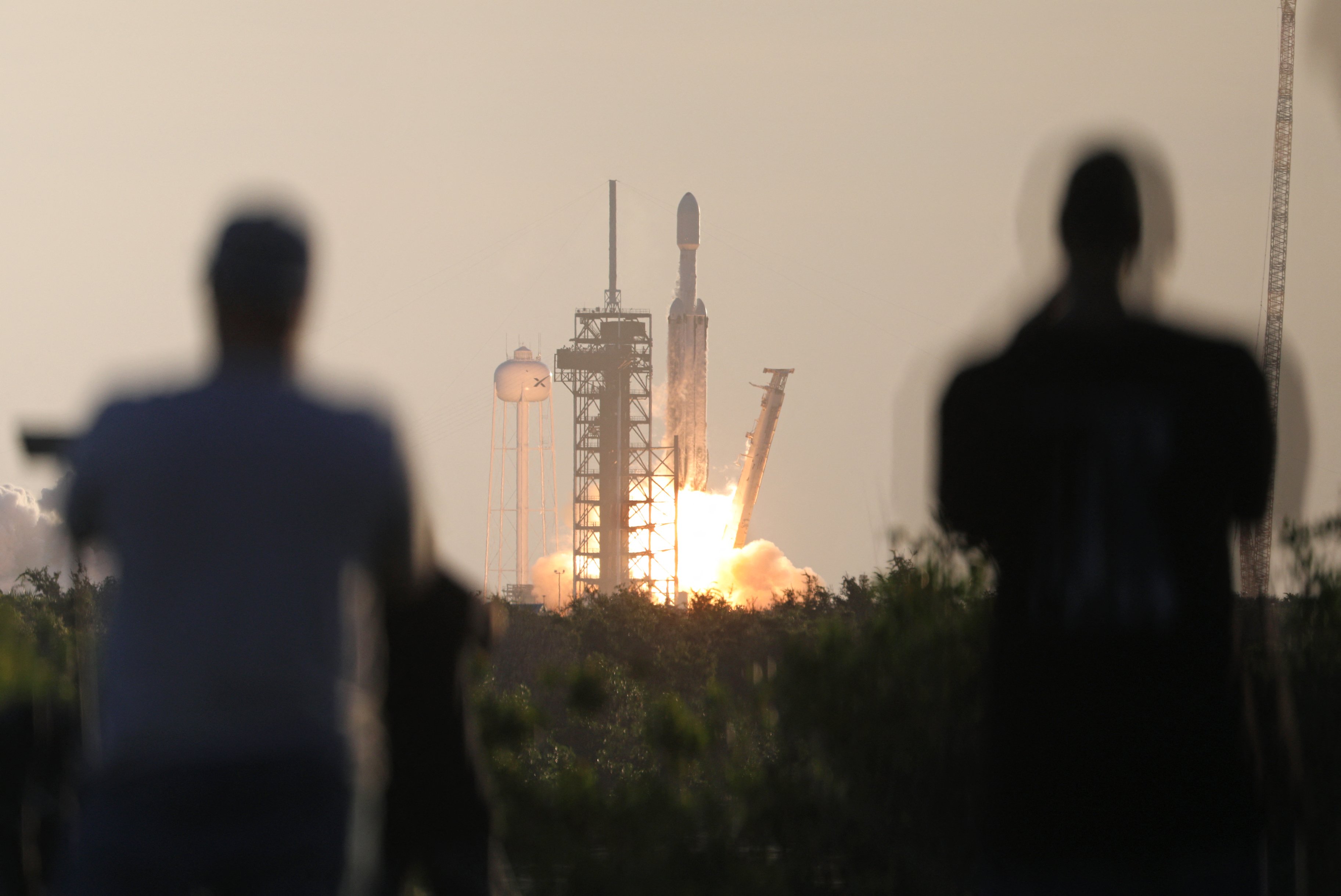
NASA launched a state-of-the-art telescope into space on Sunday that will examine hundreds of millions of stars and billions of galaxies. Its findings could provide clues about dark energy and dark matter, as well as some of the universe's greatest mysteries. The Nancy Grace Roman Space Telescope lifted off at 7:26 a.m. (Eastern Time) from NASA's Kennedy Space Center in Florida, aboard a SpaceX Falcon Heavy rocket. Often compared to the iconic Hubble Space Telescope, the Roman observatory is expected to revolutionize humanity's understanding of the universe and our place in it. The telescope is designed to cover a greater area of the sky than any previous space telescope. Over its five-year mission, it is expected to capture panoramic views of the cosmos, study underexplored regions of the Milky Way, and discover more than 100,000 planets orbiting other stars. Additionally, its study of dark matter and dark energy could provide scientists with new insights into two of astronomy's most perplexing enigmas. 'Some of the oldest mysteries of modern astrophysics are: what is the nature of dark matter and what is the nature of dark energy?' said astrophysicist Neil deGrasse Tyson, director of the Rose Center for Earth and Space at the American Museum of Natural History in New York. 'We have hypotheses, but we don't really know what they are. This telescope will attempt to provide us with the best available data to address those questions.' The mission, which costs $4 billion, has been in development for nearly two decades and its launch comes nine months ahead of schedule. This is an extraordinary achievement for any of NASA's flagship missions, made even more remarkable given that teams had to navigate the COVID-19 pandemic and public administration shutdowns this year and last, two of the longest in U.S. history. After its launch, the Roman telescope will embark on a journey of over three months to reach its final destination, located about 1 million miles from Earth. The telescope is designed to operate in a location in space known as L2—a Lagrange point—where the gravitational pull of the Sun and Earth balance, allowing the telescope to maintain a stable orbit. At L2, the Roman will join another of NASA's flagship observatories: the James Webb Space Telescope, launched in 2021. While the Roman telescope is often compared to Hubble—launched in 1990 and responsible for some of the most spectacular and memorable images of the cosmos—its capabilities far exceed those of its predecessor: it can explore the sky 1,000 times faster than Hubble, and each of its images covers an area of the sky at least 100 times larger than those captured by Hubble.
AI summary · Source: Telemundo McAllen (KTLM) →